
The grid arrives after the building
Operators in Germany and the UK have announced gas plants on their own campuses because the grid connection would come later than the data hall.
On-site power · Data centres
When the grid connection is years away, or the site is far from a substation, gas engines or turbines on site can carry the load. We check whether that works for your site, map the permits and integrate the controls.
GridPass does the feasibility, planning and controls. Engine and turbine suppliers provide the generating plant. Authorities decide permits and connections.
The problem
On-site generation is now a normal part of data-centre planning in Europe. It also brings its own connection, permit and delivery questions.
Operators in Germany and the UK have announced gas plants on their own campuses because the grid connection would come later than the data hall.
Ireland’s December 2025 connection policy requires new data centres of 10 MVA or more to bring dispatchable generation or storage that covers their full import capacity.
A plant needs a gas connection, an emissions permit and equipment with a confirmed delivery date. Any one of them can set the schedule.
How it works
We start with the three dates that decide the project: equipment delivery, gas connection and permits.
Set out the load by build phase, the expected grid date and how many megawatts the site needs until then.
Review gas network capacity at the location and the emissions rules that apply at your plant size.
Compare engines, turbines and battery share against your load shape, redundancy need and quoted delivery dates.
Design one site controller for the plant, the battery and the load, ready to run in parallel with the grid later.
What you get
The review tells you whether on-site power fits the site, what it needs and what could delay it.
Megawatts needed per phase, fuel demand, footprint, and the noise and emissions points to check.
The permits and thresholds that apply, the gas connection questions and who decides each one.
Engines, turbines and battery share side by side, with the delivery dates suppliers quote.
Fuel cost per MWh at your gas price, CO2 per MWh and emissions trading cost where it applies.
Island operation, load steps, synchronising to the grid, and the plant’s role once the connection is live.
When the grid arrives
We design the controls for all three stages from the start, so the site does not need a second integration project later.
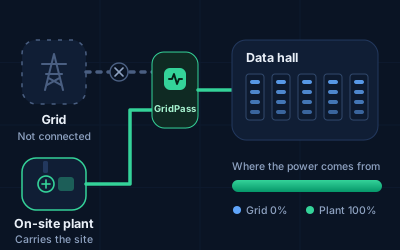
The plant carries the whole site. A battery absorbs fast load steps and keeps the engines in a steady range.
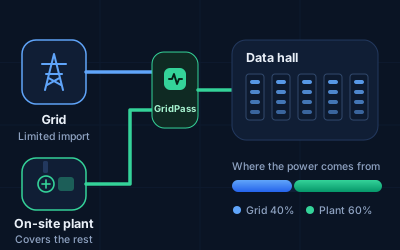
A first or flexible connection supplies part of the load. The controller keeps import within the agreed limit and the plant covers the rest.
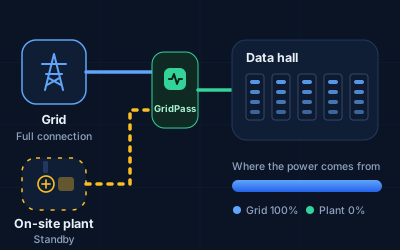
The grid supplies the site. The plant stays as backup, or as dispatchable capacity where the market and the permit allow it.
Questions
On-site gas is a bridge, and it does not suit every site. We say so when it does not.
No. We do the feasibility work, the permit and connection map and the control integration. The generating plant comes from engine and turbine suppliers, and can be owned by you or by an energy provider. We help you compare their offers.
It depends on plant size and load shape. Engines come in smaller units, which makes redundancy and phased growth simpler. Turbines put more power on less land. We compare both against your load and against the delivery dates suppliers actually quote, because delivery often decides the choice.
In the EU, combustion plant from 1 MW up to 50 MW thermal input falls under the Medium Combustion Plant Directive and needs a permit or registration. Plant of 50 MW thermal input or more falls under the Industrial Emissions Directive. Above 20 MW total thermal input the site also joins the EU Emissions Trading System. National rules add planning, noise and gas connection steps.
Gas generation emits CO2. An open-cycle gas turbine at about 30% efficiency emits roughly 500 kg of CO2 per MWh, and more efficient plant emits less. The review states the figure for your design, with the emissions trading cost where it applies. Biomethane or hydrogen blends reduce it only as far as the supplier certifies and the fuel is available at the site.
That depends on equipment delivery, the gas connection and permits. We do not quote a general figure. Checking those three dates for your site is the first step of the review.
Then on-site gas may not be the right route. The review covers the alternatives for that location, such as a larger battery, phased energisation or a different connection route, and says clearly if none of them works.
Sources
Start a conversation
Share the site details you have. We will reply with a clear next step.
Prefer to talk it through? Book a call
Available options depend on your location, site demand and network terms.