
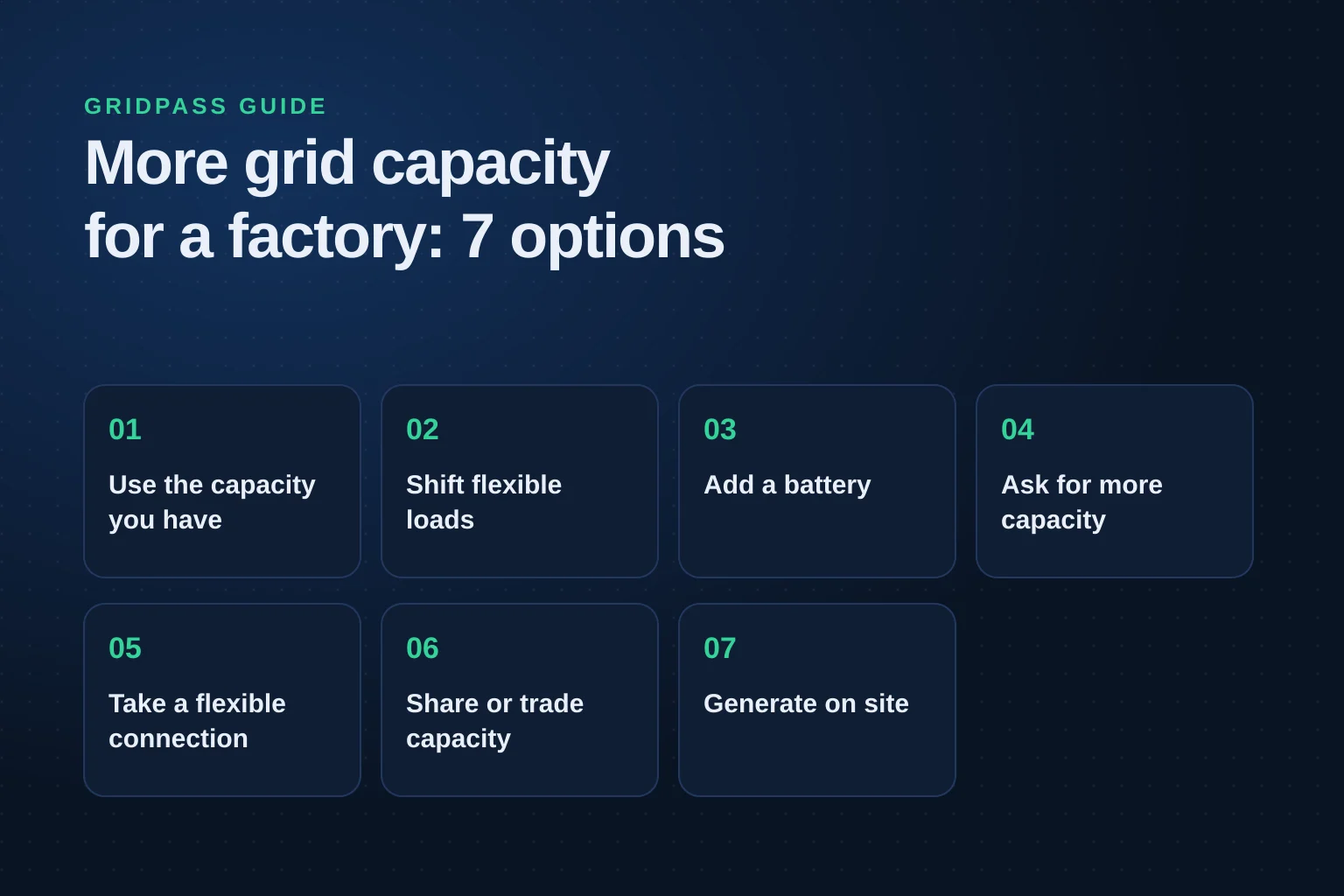
A new line, an electrified process or a row of chargers needs power the connection may not have. In many areas the network operator cannot simply raise the limit. That does not always mean waiting. There are seven routes to check, and the first three need no change to the connection at all.
1. Use the capacity you already have
Contracted capacity is the maximum your agreement allows. Most factories reach it for only a few hours a year. Look at a year of 15-minute meter data and find what causes the highest peaks. Often it is several large loads starting together, and a simple interlock or a staggered start removes the peak.
This costs the least and should always come first.
2. Shift the loads that can move
Some loads do not care exactly when they run. Compressed air with a receiver, cold stores, heating with thermal storage and vehicle charging can move by minutes or hours without touching production. Controlled together, they make room for the loads that cannot move.
Process lines stay out of this. The point is to protect them by moving everything else.
3. Add a battery
A battery covers the part of the peak that cannot be shifted. It charges when the site is below its limit and discharges when the site would go over. Size it on the actual peaks, both in power and in duration. A battery sized on a guess is either too expensive or too small.
4. Ask for a capacity increase
Ask the network operator for more firm capacity. This is the simplest result if the network has room. Where it does not, the answer may be a wait for reinforcement and a share of its cost. Ask for the expected date in writing, because that date decides whether the other options are a bridge or a permanent solution.
5. Take a flexible connection
Where firm capacity is not available, the operator may offer extra capacity on flexible terms. The site can use it most of the time and must reduce to its firm level when the operator applies a limit. EU law now asks national regulators to set frameworks for these agreements in congested areas.
A flexible connection works when the site can hold the limit reliably. That takes the same tools as options 2 and 3, plus a controller that responds to the operator’s signal and records what happened.
6. Share or trade capacity
In some countries, neighbouring businesses can share a connection, pool their contracted capacity or agree to use it at different times. Whether this is allowed, and on what terms, depends on national rules and on the operator. If your neighbours’ peaks fall at different hours from yours, ask.
7. Generate on site
Solar reduces import during the day and helps where peaks are in daylight hours. For large, continuous loads, a gas engine or combined heat and power plant can carry part of the site. Generation brings permits, fuel supply and emissions with it, so check those before the equipment.
Where to start
Start with the meter data. One year of interval readings shows how often the site is near its limit, for how long and why. That tells you whether options 1 to 3 are enough or whether you need the network operator.
Then talk to the operator with a specific request: how much extra capacity, from when, and whether part of it could be flexible. A specific request gets a faster and more useful answer than a general one.