
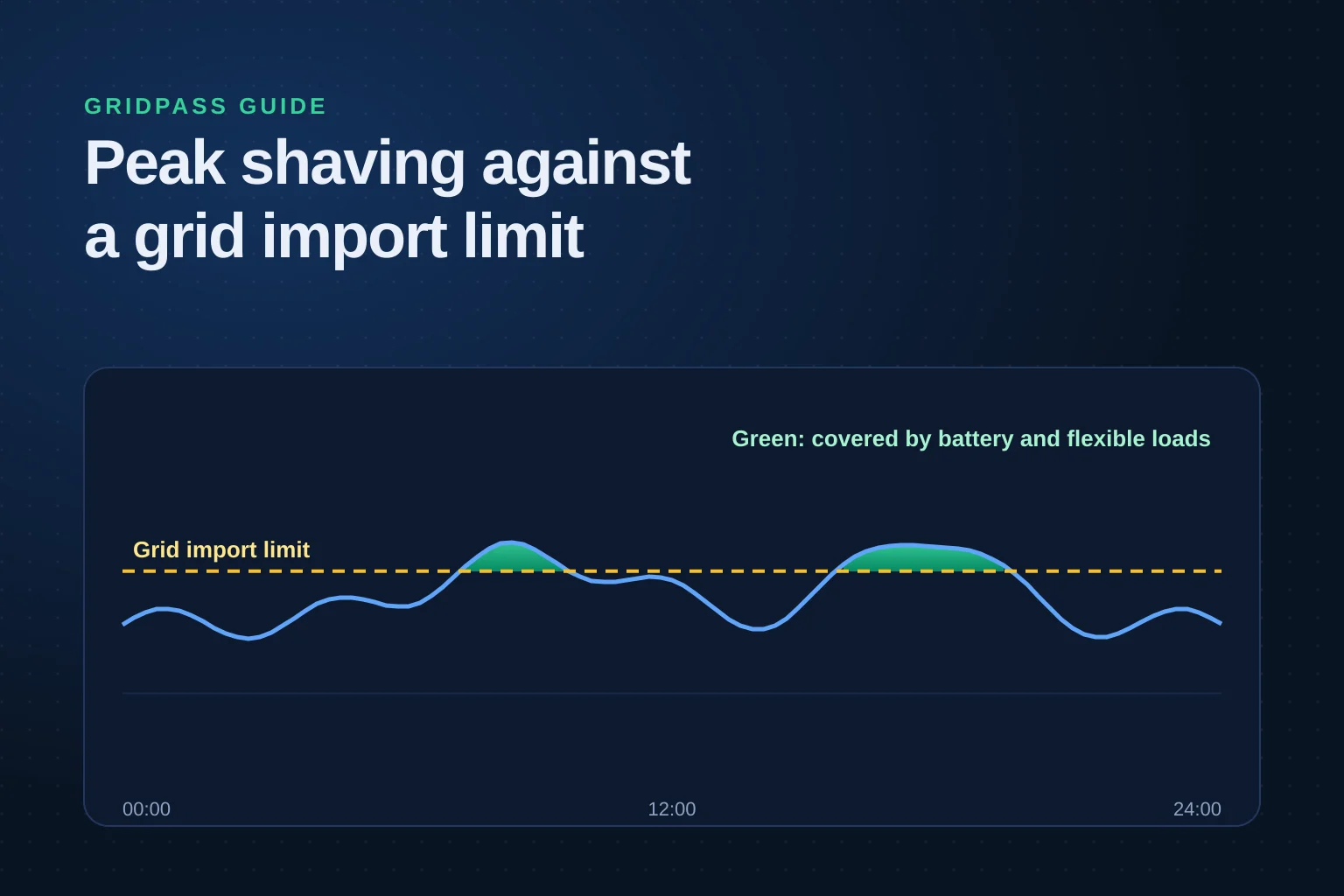
Peak shaving means cutting the highest points of a site’s power demand. Most guides treat it as a way to lower capacity charges. Missing a peak then costs some money.
A grid import limit is stricter. If the limit comes from the connection agreement, the site has to stay under it every time. That changes how the system is sized and controlled.
Start with the shape of the peaks
Take a year of interval meter data and draw the limit across it. Three numbers matter.
- Power: how far above the limit the highest peak goes, in kW or MW.
- Energy: the area above the limit in the worst event, in kWh or MWh.
- Frequency: how often events happen and how close together.
Power sets the size of the inverter and the loads you need. Energy sets the battery capacity. Frequency tells you whether the battery has time to recharge between events.
Use loads before the battery where you can
Every kilowatt a load can give up is a kilowatt the battery does not have to supply. Good candidates are loads with storage of their own: compressed air, cooling, heat and vehicle charging. Ask of each one how much it can reduce, for how long, and how long it then needs to recover.
Loads are slower and less exact than a battery. Treat them as the base of the response and let the battery do the fast and precise part.
Size the battery for the worst event, with margin
After the loads have done their part, the battery covers what remains. Size it on the worst event in the data, not on the average. Then add margin for three things: the battery will age, the load will grow, and the worst event of next year is not in last year’s data.
Check recharge as well. A battery that is empty after the morning peak is of no use for the evening one. Charging has to fit under the limit too.
What the controls must do
- Measure import at the connection point, fast enough for the response time required.
- Predict the next minutes, so the battery is not drained early in a long event.
- Decide in a fixed order: which loads go first, when the battery starts, what is never touched.
- Fail safe: if a meter, a link or the battery drops out, the site still falls back under the limit.
- Keep a record of each event: the limit, the measured import and the actions taken.
The record matters with a flexible connection. The network operator may ask for evidence that the site complied.
When peak shaving is not enough
If events last many hours, or come every day, a battery sized to cover them gets large and expensive. That is the signal to look at the other routes: more firm capacity, different flexible terms, or generation on site. The interval data will show which case you are in before you buy anything.