
Public data about data centre power is hard to find. It is often harder to know what a dataset actually measures, and whether you may reuse it.
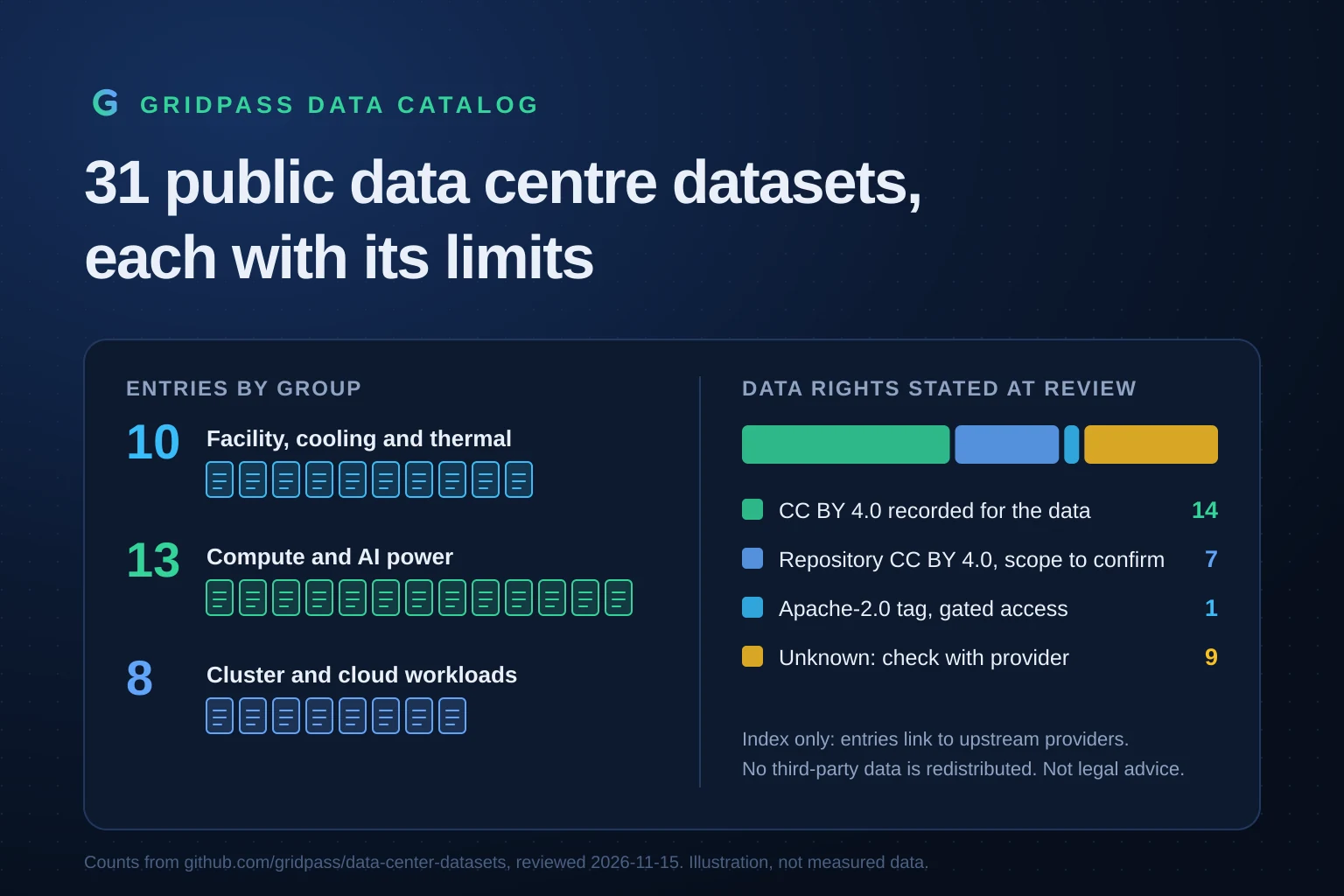
GridPass published an open index of public data centre, HPC and cloud datasets on GitHub. The index has 31 entries in three groups. Each entry links to the upstream provider and states what the data is, how it was collected, how you get it, what rights apply and what its limits are.
The catalog is one README file. It is not a data release: the repository has no GitHub releases and does not redistribute third-party data. The metadata reflects a review on 15 November 2026 and can change.
What the catalog contains
- Facility, cooling and thermal (10 entries). Examples: the Frontier supercomputer dataset, with compute power, coolant temperatures, flow, waste heat and PUE at 10-minute intervals for 2023; a Danish server room with air and server-power measurements.
- Compute and AI power (13 entries). Examples: GPU telemetry from controlled AI training sessions at 100 ms and 20 ms; LLM inference benchmarks on H100 and B200 GPUs; production LLM request traces from Azure; production GPU cluster traces from Alibaba.
- Cluster and cloud workloads (8 entries). Examples: Google Borg traces, Google PowerData 2019 with 57 power domains, Azure VM and Functions traces, an Alibaba cluster trace, and BitBrains VM and DAS-2 grid workload traces.
Each entry says what the data is not
Every entry has the same six fields: type, fields, period and cadence, access, data rights and limits. Where the catalog could not confirm a value at review, it generally records it as “Unknown” rather than a guess.
The catalog also gives general guidance on how to read its entries. Measured data includes sampled or aggregated measurements, not necessarily raw sensor readings. An observed workload is a trace of activity, not electrical power. Mixed datasets include modelled or derived values, which you must not treat as measurements. These labels are a guide only. Check each entry’s type, fields and limits before you use the data.
The limits field records problems that matter before you use the data. Two examples from the catalog: one air-cooled room dataset combines a measured 2 kW experiment with simulated cases, including fictitious 15.5 kW scenarios. For the Azure Functions 2021 trace, the dataset page and the repository README give different time units, so you must check the actual data.
Check the data rights before you reuse anything
The catalog records the data rights as stated at review. It is not legal advice. For the 31 entries:
- 14 entries: the catalog records CC BY 4.0 for the data. Attribution and the other licence conditions apply.
- 7 entries: the hosting repository includes a CC BY 4.0 licence. Confirm that it applies to the data before you redistribute it.
- 1 entry: the dataset metadata has an Apache-2.0 tag, and access is gated. Check the gating and third-party rights.
- 9 entries: the data licence and redistribution rights are unknown. Check with the provider.
Access is a separate question from rights. Some datasets are gated, very large or only available through a cloud service. For example, the Google Borg 2019 trace is available through BigQuery only, so query costs can apply. A page that opens does not prove that a download works.
The repository does not state a licence for the catalog text itself. Link to it rather than copy it.
What public data cannot tell you about your site
Most entries describe one system, one room or one controlled experiment. GPU or node power is not whole-facility power. Many workload traces have no electrical power channel at all. None of the 31 entries documents metered import at a data centre grid connection point.
This is why public data cannot answer site questions such as how close a site runs to its connection limit or which loads it can move. Those answers need the site’s own meter data, equipment list and connection terms.
How GridPass proposes to use public data
These are proposals. We do not claim measured savings or customer deployments from this work.
In a GridPass site assessment, public data can help frame the questions before site data is available. For example, short-interval GPU traces can show the kind of fast load change a control design must expect. The assessment itself stays based on the site’s own data and terms.
GridPass is also developing a digital twin simulation for data centre and factory sites. We propose to use suitable public datasets as candidate inputs for test scenarios, after we check their rights and limits. The simulation is in development and has not been validated against a customer site.
Corrections and new sources
The index is not exhaustive. Corrections and new primary-source links are welcome as a GitHub issue or pull request. Please identify the dataset release, data licence, access conditions, measurement scope and any overlap with existing entries.
If you need to assess a specific site, start with a free first GridPass site review. Tell us the site location, the current connection limit and the power you need.