
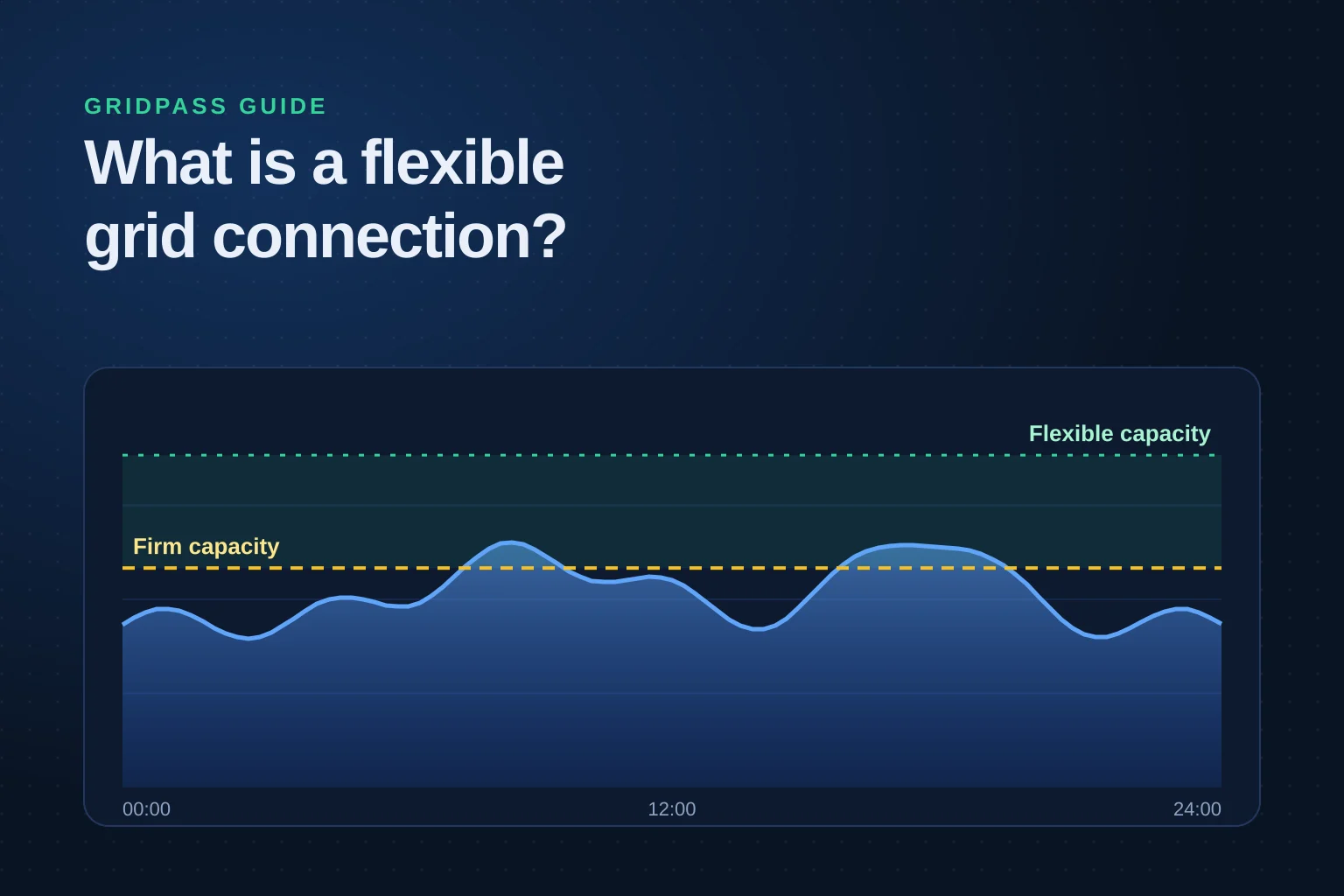
A flexible grid connection is a connection agreement with conditions. The site gets capacity, and the network operator keeps the right to limit that capacity at certain times. In return the site can connect sooner, or get more capacity, than the network could offer on a fully firm basis.
You may also see it called a non-firm connection, a conditional connection or a flexible connection agreement. The idea is the same in each case.
Firm and flexible capacity
A firm connection lets you use the full agreed capacity at any time. A flexible connection usually has two parts: a firm part you can always use, and a flexible part you can use except when the operator applies a limit.
ESB Networks in Ireland gives a simple example. A business with 2 MVA of firm capacity applies for 1 MVA more. The local network cannot provide it as firm capacity straight away, so the extra 1 MVA may be offered as flexible. The business uses it normally and drops back to its firm level when instructed during a network constraint.
What EU law says
Directive (EU) 2024/1711 added Article 6a, “Flexible connection agreements”, to the EU Electricity Directive. It asks each country’s regulator to set a framework so that network operators can offer flexible connections in areas with limited or no capacity for new connections.
Three points in Article 6a matter to a site owner.
- Flexible connections should not, as a general rule, delay network reinforcement in the area.
- A conversion from flexible to firm must be ensured, on established criteria, once the network is developed.
- Where reinforcement is not the most efficient solution, a flexible connection can be permanent.
The article also lists what an agreement may specify: the firm capacity, the additional flexible capacity by time block through the year, the network charges for each, the duration of the agreement and the expected date for the full firm capacity. It requires a site connected this way to install a certified power control system.
Each country applies this through its own rules, and the details differ. Check the terms your own network operator offers.
What it means on site
A flexible connection turns into three practical questions.
- How often and for how long can the limit apply? This decides how much energy the site must cover or shift.
- How fast must the site respond? Minutes and seconds need different equipment.
- How does the site show that it complied? The operator may ask for records of each event.
The answers decide the equipment: a battery for fast response, flexible loads that can move in time, on-site generation for longer events, and a controller that coordinates them and keeps the record.
Is it worth taking?
It depends on what the alternative is. If a firm connection is years away, a flexible one can let the site start earlier with most of its capacity. The cost is the equipment and the operating limits during events.
Before you accept an offer, test it against your own load. Take a year of meter data, or a planned load profile, and apply the limit to it. You will see how many hours are affected and what the site would need to cover them. Our replay tool does this with example data, and a site assessment does it with yours.
Questions to ask the network operator
- What are the firm and flexible parts of the capacity?
- When can the limit apply, and with how much notice?
- How is the signal sent, and what response time is required?
- What happens if the site does not respond in time?
- When is firm capacity expected, and what does the conversion depend on?
- Which control equipment and certification do you require?